
What Makes a Substack Note Go Viral? I Analyzed 1.3 Million to Find the 135 That Did
The length rule nobody talks about, the hooks that work, and why your best advice is your worst content
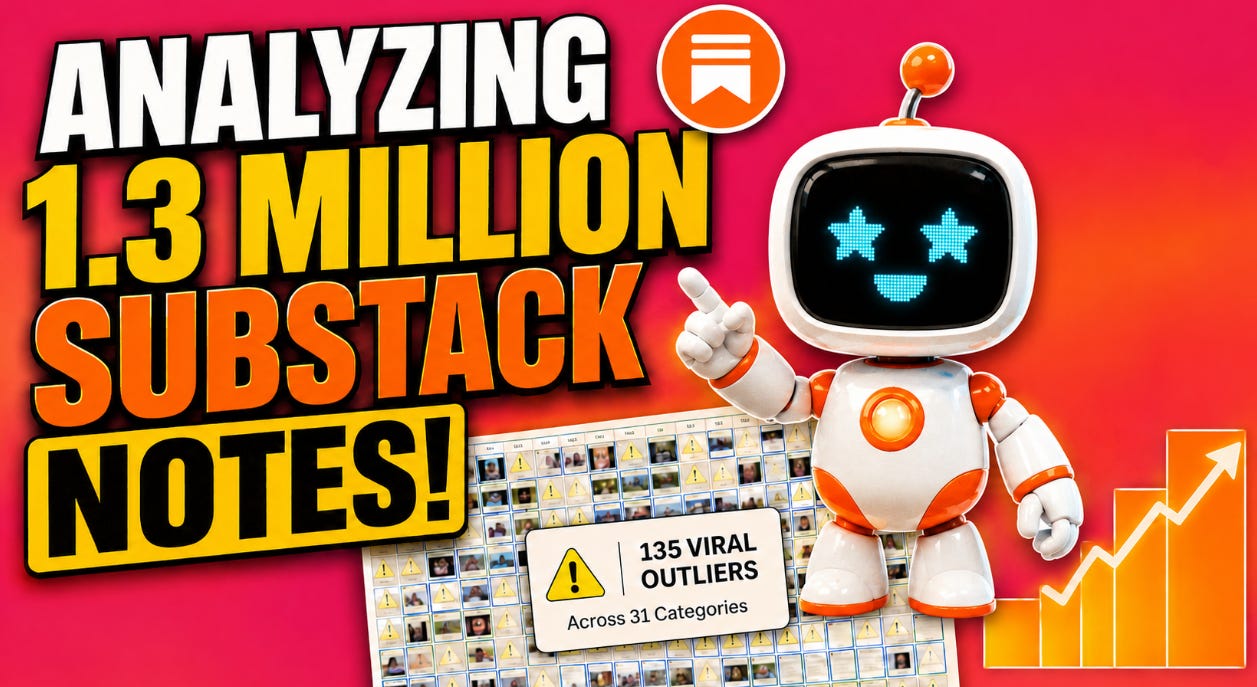
Last week I sat down and analyzed 1.3 million Substack notes. 1.3 million (!).
No human reads 1.3 million notes. So I don’t pretend to.
Here’s how I could even do this. As a full-time fullstack software developer and part-time YouTuber and owner of the .NET Web Academy I build StackBuddy, a scheduling tool for Substack writers.
StackBuddy was built for a part-time Substack bestseller and busy mom
I built this for my wife, Kristina God, MBA last summer when we went on a 3 months sabbatical to travel through Europe with our two small kids before school starts. Kristina could be all-in on Substack Notes while jumping in the pool with the kids, climbing the Monte Baldo at the Lake Garda or enjoying some ice creme in Venice while talking with a globetrotter.
It started in summer 2025 as a tool for my wife and Subsatck bestseller Kristina. Then it became a tool we offered bootcampers and Kristina’s coaching clients.
StackBuddy analyzes which Substack Notes perform well
Fast forward to summer 2026, and part of what it does is watch which Notes perform across a network of Substack publications.
Its database currently holds 1,320,475 notes from 3,742 writers, each with its reaction, restack, and comment counts.
I connected Claude, one of my personal AI assistants, directly to StackBuddy’s database and had it filter the whole set down to the viral outliers: the roughly 135 highest-engagement notes across 31 Substack categories, from writing and personal growth to grief, parenting, and mental health.
Sit with that ratio for a second. 1.3 million notes in, about 135 out. Roughly one note in ten thousand reaches this tier. That is the first finding before any analysis has even started:
true virality on Notes is rare, much rarer than the self-claimed Substack gurus make it sound. Which makes what the rare ones share worth knowing.
Those 135 I actually read, one by one, and sorted into patterns. AI did the digging. I did the reading and the judgment calls. More on the limits of that at the end.
I expected the usual answers: post consistently, be authentic, engage with others.
What I found instead was more specific, and honestly a little uncomfortable, because it disagrees with half the advice I see every day and Kristina said I, as the Chief Technical and Data Officer at home and for the Club, needed to share this with the writing community to make these insights available for everyone and also StackBuddy.
Here’s what the data actually says:
#1 There’s a dead zone, and most of us write in it
The single clearest pattern was length. And it’s not “short wins” or “long wins.”
It’s both. And neither.
The top notes were either under about 40 words, or they were 300 to 600 word stories. Almost nothing in between.
The highest-reaction mental health note in the whole dataset is one lowercase sentence. Sixteen words, no formatting. It reads like a thought someone almost didn’t post:
“i think half of modern anxiety comes from knowing too much about how everyone else is living”
72,360 reactions, 10,050 restacks, 500 comments
The biggest note in the entire dataset is the opposite. A mother tells the full story of her autistic son’s job search, beat by beat, and it opens with a line that stops you cold:
“’Your son might work in a grocery store bagging groceries for the rest of his life.’ Someone said this to me right after my son Jack was diagnosed with autism...”
98,016 reactions, 10,146 comments.
And the middle? The 100-to-250-word note with a tidy list of tips? That’s the dead zone. It’s the most common thing writers post, and it’s nearly absent from the top tier.
One punchy thought, or one real story. You pick a lane.
#2 The winning hooks are never questions or tips
I collected the first lines of the very top notes, expecting curiosity questions and bold promises.
Wrong again. The hooks that actually work come in three flavors.
A quoted line. Usually something cruel or surprising someone once said. The 98k note above opens with the sentence a stranger said to a mother after her son’s diagnosis. You cannot not read on.
A confessed number. The embarrassing specific number is magnetic in a way that round numbers and vague claims never are:
“I checked another creator’s stats. 50,000 subscribers. I had 47. I closed my laptop and went for a walk...”
26,650 reactions.
An identity claim. One line of credential, then one insight. This was the single most reliable format for educational content in the entire dataset:
28,274 reactions, 5,322 restacks. 560 comments.
The same move works even when the credential arrives mid-note:
“You used to get your best ideas in the shower. Now you have a waterproof phone case... As a neuroscientist, I can tell you - your brain needs those gaps.”
44,796 reactions.
What almost never appeared at the top: notes opening with a question. Notes opening with “here’s a tip.” Notes opening with a promise to teach.
You may have noticed this article opens with a confessed number.
3. Validation beats advice
The advice-shaped notes that did break through didn’t actually give instructions. They gave permission:
“Sensitive bodies are hard to exploit. They revolt against forty-hour workweeks... Your sensitivity isn’t a disorder. It’s your body’s refusal to participate in collective dissociation.”
21,500 reactions, 3,200 restacks.
One of my favorites reframes digital addiction as an emotion problem, not a discipline problem:
“Digital addiction isn’t a phone problem. It’s an emotion regulation problem People use their devices as a way to avoid stress or unpleasant feelings...”
22,700 reactions, 1,000 restacks
Meanwhile, hustle content, the “wake up at 5am and dominate” genre, was almost completely absent from the top tier.
People don’t react to being told what to do. They react to being told they’re not broken.
If you remember one thing from this article, make it that sentence.
4. Reactions and comments are different games
Here’s a subtlety I haven’t seen anyone write about.
Short aphorisms earn reactions. Enormous piles of them. But their comment counts are tiny. The 72k anxiety one-liner above collected just 509 comments.
Stories earn restacks and comments. The 98k story about Jack drew over 10,000 comments. Twenty times more conversation on roughly the same reach.
And one format earns comments like nothing else: the participation note. Two months before the 98k note, the same writer posted this about the same job search:
“My son Jack has autism. He is twenty-one. He has been looking for a job for four months... Please join me in congratulating him on this incredible accomplishment.”
51,636 reactions, 4,731 comments
Reacting was the requested action. Readers weren’t an audience, they were guests.
💡So before you write, ask what you actually want. Reach? Write the one-liner. Conversation and new subscribers? Tell the story. Don’t judge a story by reaction count or an aphorism by its comments. They’re different instruments.
5. The winners repeat themselves. Literally.
Something I already heard from Kristina’s creator friends: great notes don’t expire. The same material keeps working.
The cleanest example in the dataset is a three-word opener that went viral twice, a month apart, from two different science writers:
17,137 reactions, 2000 restacks
Nearly identical words. Both times, five figures of reactions. The audience did not care that it had run before.
💡Kristina told me often online writers treat their old notes like expired milk. The data says they’re more like songs: if it was good, play it again. Most of your audience never saw it the first time, and the algorithm doesn’t care.
If reposting feels wrong to you, rework the same idea in new words. But stop letting your best material retire after one day of life.
What you need to know about the analysis
Now the caveats, because data without caveats is just marketing.
This is one network’s view of Substack, not the whole platform. The numbers describe the viral ceiling, not the typical note. Everything here is correlation, not causation: I can tell you what the winners have in common, not that copying it will make you win. And a handful of huge accounts inflate some raw figures, which is exactly why I focused on patterns across topics instead of absolute counts.
But the patterns held across 31 very different niches, from grief to productivity to art.
🪶What the data suggest🪶
Pick your best idea from the last month/week. Write it twice: once as a single thought under 40 words, once as a 300-word story from your own life.
Open one with a number you’re slightly embarrassed by. Open the other with something someone actually said to you.
Post both this week. Watch which one your audience answers.
Meet your StackBuddy for FREE
Based on the feedback I received I finally feel ready… All subscribers of the Club can now meet StackBuddy and all the incredible tools he can help you with. Analyzing notes of your publication, the notes of others in your category and seeing what drives paid growth is just one of them. Scheduling your whole summer break is easy and fun
I built StackBuddy, the tool this data comes from, for my wife so she wouldn’t need to be on Notes all the time and be “all in” by focusing on interactions.
Every new account currently starts with 14 days of full Pro, free.
If you want to test the patterns above with a real queue behind you, this is a good summer week to try: stackbuddy.io
Psst… Kristina here.
All subscriber gonna see an invite in their inbox to our 🌊🌊Summer Substack Notes Scheduling Pool Party with StackBuddy 🌊🌊 this week!


So interesting!