



Most Substack advice focuses on growing your subscriber count.
I did that. And it worked. . . well, sort of. I followed all the advice and was able to double my subscriber count from 1500 to nearly 3000 in just under two years. I even got some paid subscribers to bring in about $150/month.
But $150 wasn’t what I wanted.
So I kept that publication going and used it as a control study to an experiment, and opened another publication, and shifted my attitude about money.
I learned that the real secret to monetization is about my relationship with money itself!
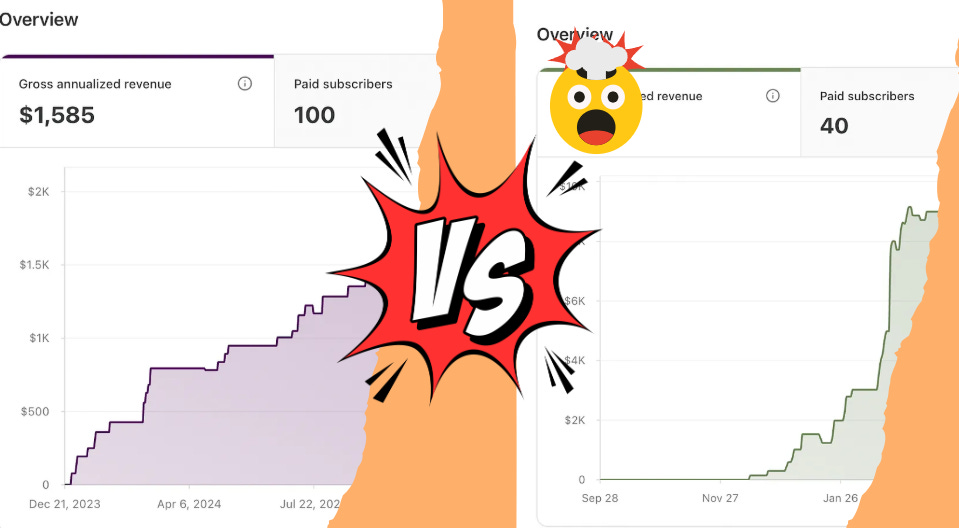
The results of this experiment showed two very different publications with dramatically different results:
2877 subscribers = $150 per month.
702 subscribers = $1500 per month.
Let’s compare.
3000 Subs - The Growth Strategy That Isn’t Working
I followed all the “proven” Substack advice:
✓ Consistent posting schedule
✓ Engaging in Notes and comments
✓ Optimized welcome sequence
✓ Monetization Strategy = webinars, workshops, mini-programs, paywalled posts
This is my publication with almost 3000 subscribers.

I imported about 1500 subscribers and have worked steadily, following all the advice above to grow subscribership over the last (almost) two years.
While the metrics say I have 100 paid subscribers, most of those I comped as I grandfathered in my private clients.
The true figure is 22 paid subscribers paying $5.55 to $7.77 per month for a total of about $150 per month.
With this strategy, I find myself burning out and feeling like the content and my enthusiasm goes stale in cycles.
700 Subs - The Growth Strategy That Is Working
This is my other publication, with barely 700 subscribers.
✓ I started from zero
✓ I collaborated with trusted substack friends
✓ I launched a targeted campaign for a small-group cohort program
✓ Monetization Strategy = a high ticket small group cohort program with replay content available in paywalled posts as self-study to paid subscribers.

I started from zero and built the subscribership from scratch with a launch campaign in December 2024 calling for applications to a closed cohort program in January 2025.
That program started in March.
The income figures here aren’t completely accurate either.
The cohort members became founding members by paying an initial founding member annual rate to have access to the substack posts, and they continue to pay me monthly (off of Substack) for their weekly cohort meetings.
In addition to the cohort founding members, I have a number of paid subscribers who have access to the content but are not part of the small-group cohort.
In total, I earn about $1500+ per month from this publication.
High-Ticket Offers or Is My Audience Ready For a Premium Offer?
Here’s the thing that confused me: I’d attempted running high-ticket programs from Publication #1 multiple times. All my efforts to offer premium coaching packages, exclusive workshops, and small-group intensives flopped. Every. Single. Time.
I’d get maybe 1-2 applications when I needed 5 to break even and 10 to turn a profit. Or people would express interest but never actually sign up. I kept thinking my audience wasn’t ready for premium offers, so I went back to low-ticket, high-volume strategies.
It didn’t make sense, I was marketing to a larger audience and not getting the results.
It wasn’t my audience.
(gulp)
It was me.
The Money Mindset Shift That Changed Everything

The difference was actually because I started Publication #2 from scratch and because I changed my relationship to money entirely.
As a result, Publication #1 was built from scarcity. Publication #2 was built from worth.
Publication #1:
Underpricing everything to be “accessible”
Chasing volume over value (quantity over quality)
Feeling guilty about asking for money
Operating from “I hope someone will pay me”
Publication #2:
Pricing based on transformation delivered
Focusing on quality relationships
Confident in my value
Operating from “This work changes lives”
Let’s Pull Back The Wizard of Oz Curtain
The truth is, both strategies can work, with the right implementation, the right marketing approach, and the right energy behind the campaign.
The real difference was the energy and mindset I brought to the strategy!
The difference was my nervous system’s relationship with receiving money.
You can have a perfect strategy and thousands of subscribers, but if you’re unconsciously rejecting money, none of it works.
Every time I thought about monetizing, my body would revolt. Heart racing, throat closing, physically sick feeling.
These weren’t conscious thoughts, they were wired into my nervous system. So I unconsciously sabotaged every monetization attempt.
My money blocks showed up everywhere:
Chronic underpricing
Avoiding direct asks
Over-delivering to avoid feeling “salesy”
Chasing subscriber counts instead of subscriber quality
⁉️Quick test:
What happens in your body when you think about doubling your prices?
That reaction tells you everything.
What Actually Changed Between Failed Launch and $1500/Month
In starting from zero with Publication #2, I approached the whole project from a place of passion, and JOY!
And. . . I adjusted my relationship with money.
I told myself that this isn’t about the money, it’s about the FUN!

I did the inner work first. I traced my reactions back to inherited money beliefs like
“Good people don’t ask for money”
“Charging for help makes you greedy”
“Spiritual work should be free”
I let those all go and said to myself,
“I want to do this, I’m gonna do this for the fun, and if I make money that’s an added bonus!”
As a result, Publication #2 feels completely different. I’m having a blast creating content, connecting with my community, and yes, making money.
When monetization feels aligned instead of forced, everything flows.
Your Logical Next Step - Start With $50

If you’re struggling to monetize despite engaged subscribers, the problem might not be your strategy. It might be your nervous system’s response to money.
I’ve decided to try this whole fun-cohort thing again, with a third publication.
I’ve collaborated (because community is a key component) with Dr. Axel Meierhoefer 🏕️🔥, and am working with several substack friends to promote this with me.
We have 301 subscribers,
Offering a 9-week mid-ticket cohort program addressing these exact issues about money, mindset, and flipping that switch in your nervous system.
Learn more HERE:

I’m hoping this third go-round will help me break even more of those money patterns that don’t serve me.
14 spots left!
Applications close tomorrow.
I have no idea if it will work, but I’m gonna laugh and play my way through trying.
Will you join me?
Sometimes Substack success is about healing the parts of you unconsciously pushing away the success you’re working toward.
Join The Abundant Money Mindset Program

Initial investment only $50!
12pm Eastern Timezone
A 9-Week Journey to Financial Empowerment

94 days until the year is over! Still time to crush your goals!
Big thanks to founding member Dr. Axel Meierhoefer 🏕️🔥 and Teri Leigh 💜 for pulling back the curtain and sharing their journey with us. These are the kinds of real stories you don’t find in “$10,000 in 30 days” posts, they’re controversial, and actually useful.
“If you’re serious about shifting your money mindset and expanding what feels possible, this is where it starts: by being around people like this who prove it’s doable.”
Axel built a 10-property portfolio and helps entrepreneurs reach financial freedom.
Teri has 30+ years of experience, taught 200,000 students, and mentored thousands in spiritual growth.
Together, they bring practical wealth and soulful mindset—the mix that makes their work so powerful.
So let’s close with Axel’s own words:
“Let’s keep building abundance together.”
Your Turn!
I know a lot of you are wrestling with this right now:
How do you feel about asking for money or charging for your help?
What happens in your body when you think about doubling your prices?
Drop your thoughts in the comments or the community chat, we’d love to hear where you’re at!


The right niche makes a lot of sense to me. I see success in marketing scale from Substack posts turned toward other non-Substack business.
This is a valid example that niching down on something more specific with transformation in mind can actually move the needle.
Or in an automotive way: the second option doesn't need as much fuel (overall subscribers) to achieve the same outcome (distance driven) - as if the second pub is powered by Diesel.