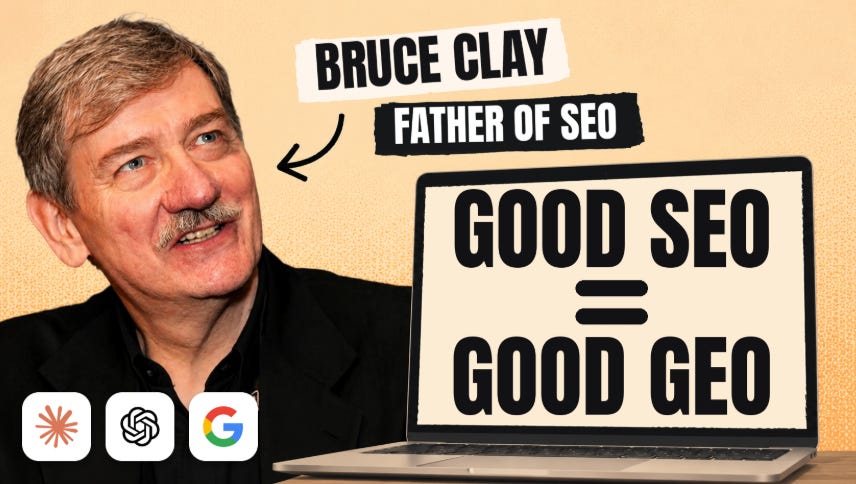
Is SEO Dead in 2026? The Father of AI and Google Just Answered That For Writers
Bruce Clay died, but his legacy is still alive. Google just confirmed everything he taught
“SEO is dead. GEO is the future. AI killed search, better learn the new rules or get left behind.”
If you write anything online, a blog, a Medium post, a Substack, a LinkedIn update, a YouTube script, you’ve heard some version of that the last couple of months. Probably ten versions. And if you’re honest, it made your stomach drop a little.
So let me say the quiet part out loud: most of us just want to write. We don’t want to decode five new acronyms a quarter (SEO, GEO, AEO, LLM SEO, enough). We don’t want a brand-new “system” something changes. We want the thing we wrote to get found by a human who needs it. And lately it feels like the robots changed the locks. I feel you!
So here’s the question:
Is SEO dead? Is GEO the next big thing in 2026/2027? Do you have to throw everything out and start over?
Short answer: no, kind of, and thank goodness no. The longer answer is the most reassuring thing you’ll read all week and the best proof of it comes from a man who answered this exact question three decades before anyone thought to ask it. We lost him a few weeks ago.
Let me tell you about a man you’ve probably never heard of, who shaped almost every word you’ve ever typed into a search box.
His name was Bruce Clay, and the industry called him the Father of SEO. That’s not a cute nickname. He has even coined the term “search engine optimization (SEO),” back in 1996, before Google even existed.
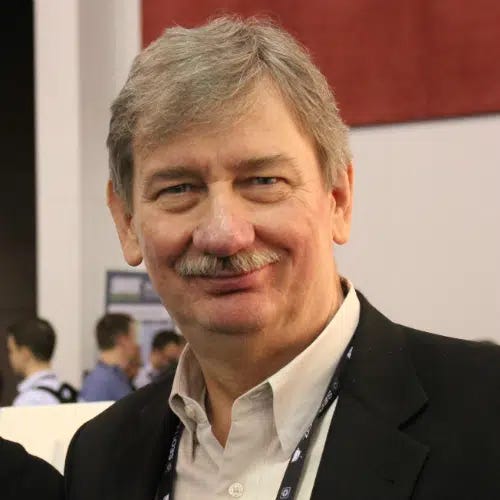
Bruce was a mainframe programmer who started his company at his dining room table, treated Google like a puzzle to solve instead of a slot machine to game, and then spent three decades teaching the rest of us how to do it honestly.
He passed away in late May 2026.1 The news rippled through the SEO world a few days ago, and I’ve been sitting with it, because Bruce is part of my story too.
I learned this craft in my early twenties, journalism degree, media and communications, then being a TalentEd at the biggest CommsMarketing agency in the world, Edelman, where I watched words move markets in real time.
Later I did my MBA in marketing and dialogue marketing. Somewhere in all of that, Bruce Clay’s checklists and guides were quietly teaching me the fundamentals nobody else bothered to explain in plain English. I owe him more than I realized until this week.
His entire philosophy fit in one line from one of his checklists:
“Your website must be technically sound and the content must be useful and trustworthy.”
So this issue is a tribute. But it’s also the most tactical SEO lesson I can hand you right now and the timing of it is almost spooky.
Table of Contents
The Bruce Clay eulogy Google didn’t know it was writing
Here’s the eerie part. Only a few weeks after the world lost Bruce, Google published a piece by one of its VPs, Brendon Kraham,
with a headline that reads like something Bruce would have stitched on a pillow: “Good SEO is good GEO.”2
It opens with a sentence Bruce could’ve written himself:
“You win by being relentlessly helpful.”
Reading the whole thing felt like watching Google confirm, in writing, that the guy who just died was right the whole time.
What are SEO and GEO?
If you’ve been nodding along pretending to know, this part’s for you. No judgment!
SEO = Search Engine Optimization. Everything you do to help Google show your page when someone searches. Useful words, a clear title, a fast page, content people actually want.
GEO = Generative Engine Optimization. The new kid. Same idea, but for AI answers. The summary at the top of Google (AI Overviews, AI Mode) or the reply ChatGPT gives. GEO is about getting your work cited inside those AI answers.
You’ll also hear AEO and LLM SEO and three new acronyms by the time you finish your coffee. The punchline, straight from Google: they’re basically the same thing. Google’s AI features pull from the same index, ranked by the same quality systems, as normal search. So you win an AI answer the same way you’ve always won search.
Bruce spent 30 (!) years saying that. Google just put it on a page.
I hear you say:
“Kristina, okay, but what should I actually do to be come findable on search?”
Here are some tangible tips, pulled straight from Bruce’s checklist and Google’s new guidance, translated for those of us who’d rather learn from this summary than spending hours on digging deeper into this topic.
3 tricks that make AI quote you — not your competitors
Give up the answer in the first line. Bruce’s whole “featured snippet” strategy was: ask the question, then answer it cleanly and immediately. That clean, direct answer is the exact sentence AI Overviews and ChatGPT lift and cite. So put the payoff up top, bury the lede to “build suspense” and the robots (and the skimmers) go quote someone else.
Say the thing only you could say. Google now tells brands to ditch generic content and share “noncommodity content”, stuff only you can write. Their example: a running store shouldn’t publish “Top 10 Shoe Tips” (a robot can do that);. It should publish a teardown of why one specific customer’s shoe fell apart. That first-hand angle is the first “E” in Bruce’s E-E-A-T (experience, expertise, authoritativeness and trust) factor and it’s the one thing AI can’t fake, so it’s exactly what gets you cited.
Don’t let your best piece go stale. Bruce’s most famous article was a checklist he never stopped updating, its comments run from 2018 to 2026. Google rewards freshness and AI engines prefer current sources, so a refreshed 2026 post beats your buried 2021 one every time. His rule of thumb:
~50% new content, 50% improving what already works.
Platform playbook: how to get cited on each one
Your own blog or website, the source AI trusts first
One unique title tag + meta description per page. Bruce called this your prime real estate, don’t waste it. Specific, compelling, topic up front.
Make it fast and mobile-first. Google’s words: display well across devices, reduce latency, make it easy to find the main content. Compress images, serve WebP, ditch the pop-ups that block your content.
Structure with real headings. One H1, then H2s and H3s like a table of contents, a question or key term in the heading, the answer right below.
Build silos and internal links. Cluster posts around 2–3 core topics and link them together. That’s how you turn scattered articles into topical authority (and how AI maps what you’re an expert on).
Add light structured data (FAQ or Article schema) so you’re eligible for rich results and refresh your top posts on a schedule.
Medium: borrow a domain Google already ranks
Headline = prime real estate. Specific and clear, topic front-loaded, skip clever-but-vague.
Subheads are your table of contents. H2s with a real question or key term, answered underneath.
Link your related pieces together: Bruce’s siloing, Medium edition.
Substack: turn loyal readers into authority signals
Your subject line is the title tag AND the meta description. It earns the open and sets the promise. Specific and benefit-driven beats mysterious.
Pick 2–3 core themes and go deep so new subscribers can binge a coherent body of work.
One clear call to action (CTA) per issue, subscribe, share, or reply. Bruce’s CTA rule.
Subscribe now for free to get:
Expert insights from the “Substack Queen” and soon-to-be published author.
Proven writing strategies to kickstart your writing journey and grow faster.
Advice from a Medium top writer, Substack bestseller and award-winning marketing expert to earn more money, traffic, higher search ranking and increased visibility for your work.
LinkedIn: become the expert AI quotes
Win the first two lines. Everything above the “…see more” cutoff is your snippet. Lead with the hook.
Be the internal expert. Google says to showcase your experts and unique POV. “Here’s what happened when I…” beats recycled (AI sloppy) advice.
Talk like a human, not a keyword. As Google puts it: “Our systems understand language just like a human.” Your real voice is the optimization.
YouTube: give the AI a transcript it can lift
Answer the question in the first 15–30 seconds. Google surfaces video inside AI answers, give it a clean, quotable hook.
Write a real transcript and accurate captions. Bruce listed these for video: they make your content crawlable and quotable by AI. Don’t rely on auto-captions. E.g. my name “Kristina God” is written incorrectly most of the time. Same with the platform “Substack”.
Use chapters and a keyword-rich title and description, and link related videos. Specific demos beat generic explainers.
The stuff Google says to STOP doing in 2026/2027
Stop keyword-stuffing or chopping your writing into weird AI-bait fragments. As Bruce put it: “Keyword optimization today is less about repetition and more about clarity.”
Stop chasing special “AI files” and hacks (LLMs.txt and friends) — not needed for Google.
Stop publishing the generic listicle anyone could’ve written. In Google’s framing, your unique take is “noncommodity content. And that’s a competitive advantage.”
Stop obsessing over vanity metrics. Google says measure what actually matters — leads, sales, sign-ups, replies.
What this means for you and me
If you love writing, this is the best news you’ll get all year. The one thing AI can’t do is be you. It can’t have stood where you stood, made your mistakes, or learned your lessons. The whole game , search, AI, all of it, is tilting toward the writer with genuine experience and a real voice.
That’s not a new strategy. It’s Bruce Clay’s original one, the one I learned at 23 and have watched outlast every algorithm panic since.
Be useful. Be honest. Write from experience. Keep your best work current. Build trust on purpose.
Bruce literally co-wrote “Search Engine Optimization All-In-One For Dummies” because he believed this stuff should be understandable by anyone willing to learn, not gatekept behind jargon. That’s the energy I’m carrying forward here, every week, for you.
Rest easy, Bruce
This past week, the SEO community is mourning one of its true pioneers. Through his work, his tools, his books and his teaching, Bruce Clay helped turn a scrappy side-hustle into a real profession and quietly trained thousands of us, including me, in the process.
Rest in peace, Bruce. Thank you for everything.
The fact that Google spent June restating your life’s work, a fwe weeks after we lost you, might be the most fitting tribute of all.
You were right the whole time.
Bruce Clay Inc., Bruce Clay passed away
Good SEO is good GEO, Google Business


This is excellent, Kristina. Thank you for adding your EEAT to Bruce’s. I’ll definitely refer back to this and share it.
This was fab to read. I’ll be happy to refer back to it every day. Thanks so very much.🥂