7 Things Attending the Leipzig Book Fair Taught Me About the Future of Indie Publishing
If you have a story inside you, this shift matters more than ever
For weeks now, through the conversations with my coaching clients in the Beyond Membership1 I’ve been thinking about the future of publishing.
Because a few months ago, I was at the Frankfurt Book Fair. That’s the biggest book fair in the world. The place where rights are sold, deals are made, and the industry defines itself and the cool thing is, it’s in Germany. Yay.
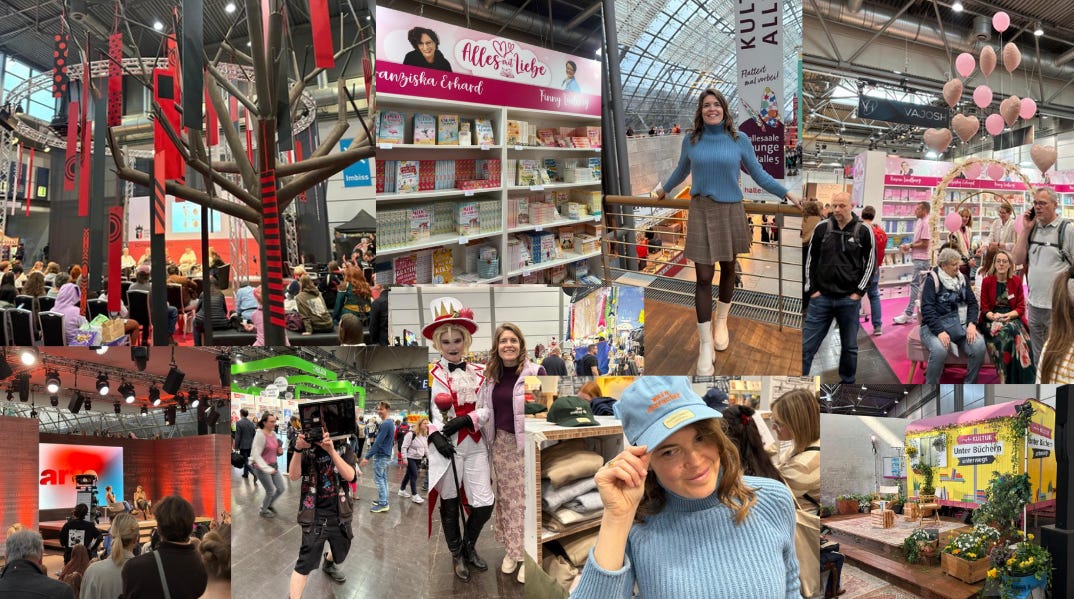
And now, a few days back, I attended another event for book lovers called Leipzig Book Fair in the middle of 300,000+ readers from 54 countries.
And somewhere between packed halls, quiet conversations, and one very unexpected downpour… something became very clear to me looking at the Book Fair with a beginner’s mind:
The center of publishing is steadily shifting and there’s now an era for the small guys.
And if you’re writing a book or thinking about writing a book. Or quietly carrying a story inside you…this matters.
Table of Contents
1. Frankfurt Book Fair vs Leipzig Book Fair
2. Publishers are data-driven gatekeepers
3. Word of mouth looks different but is as important as ever
4. Earning 10% from your book is not enough
5. Indie publishers are writing and publishing without permission
6. Indie authors are quietly building support systems with AI
7. Marketing for book authors is becoming more important than ever
1. Frankfurt Book Fair vs Leipzig Book Fair
If you’ve never been to the Frankfurt Book Fair I can tell you, as the leading Book Fair in the world happening in the Little Big Apple, it’s super impressive.
You walk through the buzzy halls and you feel it:
This is where decisions are made. This is where books become products. This is where global publishing moves. This is where to pitch my story or my designs.
It’s of course where hundreds of thousands of readers show up, 240,000 (with 118,000 trade visitors!) to be specific. In comparison, Leipzig reached a record of 313,000 (with only 55,000 of them being trade visitors!).
So in my view the numbers alone show, Leipzig is different. It doesn’t feel so business-y and it’s where readers show up, cosplayers, manga and comic fans and loads of indie publishers.
I saw teenagers sitting on the floor reading or playing card games. I saw people carrying five, six, seven books at once (okay, maybe it was me in the mirror!). You see lines forming around authors you may have never heard of. You see colourful and unique looking booths or simply a table with some decoration.
And suddenly I realize:
This is the book fair for indie publishers and raving (book, manga, comic, cosplay) fans. A fair for the small guys who want to be independant.
2. Publishers are data-driven gatekeepers
Right before Leipzig, I watched an interview with Jon Yaged, the CEO of Macmillan Publishers.
And one sentence stayed with me:
“There were a bunch of people out there reading things or wanting to read things that we weren’t publishing.” 2
That sentence followed me through Leipzig.
Because everywhere I looked, I saw proof.
Genres exploding that feel almost invisible in traditional catalogs. Niche fiction, hybrid formats. Books that feel personal. Specific. Sometimes even a little rough.
And still: people were buying them.
They were not “approved” by a data-driven gatekeeper like a big publisher. They connected.
And that tells me something important: Demand exists before the industry recognizes it.
“I would say conservatively we publish less of than one in 10. It’s probably more like one in 20 or 30 (…)”
3. Word of mouth looks different but is as important as ever
There is this idea that marketing sells books. I know many hate selling.
But what I saw, and what Jon Yaged confirmed, is something much simpler.
The best way to sell a book hasn’t changed. Write a great book. Word of mouth does the rest.
“(…) word of mouth just looks different today. It used to be the trusted reviewer. There used to be a scholarly review. Um, then it was, you know, for a while we had bloggers, you know, we had independent book sellers and librarians in particular that were really influential bloggers. This is going back, call it 15 years ago, and they were really driving sales and then it became Instagram and now it’s Tik Tok, but it’s still what it is. It’s word of mouth, right? It’s a trusted source giving you a recommendation.”
At the Leipzig Book Fair I heard people say:
“I saw this on TikTok.”
“My friend told me about this.”
“You have to read this this influencer recommends it.”
Today, word of mouth doesn’t happen in small circles, such as the blogosphere as in the past, it now happens online, spreads faster and scales.
One great example is BREANNE ✨ RANDALL who went from indie publisher to NYT bestselling author by mastering social media and becoming her own social media expert.3
4. Earning 10% from your book is not enough
Yaged from Macmillan also broke down the numbers and once you hear them, you can’t really unhear them.
If a book costs around $30:
more than half goes to the retailer
the author gets around 10 to 15%
the rest covers production, logistics, teams
And then you talk to authors in Leipzig and hear them speaking on the stage. And you hear something that sounds very familiar:
“You still have to promote your book.”
“After launch, it’s on you.”
“Social media is basically expected.”
And that creates a tension.
Because on the one hand: traditional publishing offers reach, structure, validation.
But on the other: the author is still responsible for becoming visible … and that’s where many start to ask:
“What exactly am I giving up… and what am I gaining?”
An indie publisher told me earning only 10% versus earning 80 to 90% is not a fit anymore, especially since there’s always the marketing questions:
“How many followers do you have?
How many subscribers do you have?
Who do you know that has a huge platform?
Who would help you promote the book?
How could you promote the book via your social media presence?”
So it’s up to you to decide:
Will I give my book baby in the hands of a publisher or better self-publish?
Or maybe start self-publishing and then later go with a big publisher?
5. Indie publishers are writing and publishing without permission
One of the most striking moments for me was a conversation with a woman from Germany at the fair.
She told me she was over 50. That her children had moved out and she had always wanted to publish the book that she had written in her her journal.
So in January, she decided:
“I’m publishing my book now!”
The book wasn’t finished. But she committed.
By March 2026, she was standing at the Leipzig Book Fair.
Her stand was small. A table. Some decoration. A typewriter. Her books.
She told me it cost her over €2,000. She even had to pay an extra $400 someone just had told her.
And yet, she was there, smiling, talking to readers, telling her story, selling copies and her hubby was with her.
What stood out was not the setup. It was her presence. Her smile. Her clarity. Her willingness to show up.
And throughout the Book Fair I started to see a pattern that I also discovered in my 20s when I followed my (back then) boyfriend Patrick God to the Gamescom, the world's largest gaming event, in Cologne.
Indies aren’t waiting for someone to grant them permission. They are building their thing. They are writing their book. They are giving birth to their babies even if it takes months or years.
6. Indie authors are quietly building support systems with AI
Not every indie author has:
a strong network
supportive friends
people who understand what they are doing
Some told me very openly:
“People around me don’t really believe in my book.”
That can feel isolating. So they find other ways.
And this is where AI comes in as support.
They use it to:
check spelling
format their books
get a second opinion
get the motivation they need
ask questions when no one else is there
Almost like a quiet companion. A buddy.
A way to keep going. I never thought about AI and indie publishing that way but of course often you write while others are doing partying, living their lives, sharing the best pictures on social media, while you’re sitting their with dark patches under your eyes writing your way to finally birth your book baby.
And when you think about AI like that it makes a lot of sense, is really good for your mental health and helps so many indie publishers now finally to dare to publish their books.
7. Marketing for book authors is becoming more important than ever
This is where things get uncomfortable for many, I know.
Many of you, understandably, want one thing: to write.
“I’d rather be writing, Kristina!”
I know this…
But what I kept hearing, in Leipzig and beyond and I can’t stress this enough (well, I am a marketer!), is this:
“What’s your audience?”
“Who can help you promote?”
“What’s your reach?”
Even authors who are traditionally published said:
“After the initial push during prelaunch and launch, you are responsible.”
And that changes the role of the writer because you are creating attention.
Attention is as you know the most valuable currency on the internet. Especially owned attention, in form of subscribers.
Some love that. Some really don’t.
Substack connects all of this and what CNN has to do with it
Because what I saw in Leipzig with the indepent publishers…is already happening online. On Substack.
You write. You publish. People read. They reply. They re-stack. You build something slowly. And over time: word of mouth starts working for you.
Before I even left for the Leipzig Book Fair and during the Grand Finale and Q&A of my LinkedIn-Substack Flywheel Bootcamp (get immediate acccess now to the value-packed, actionable course) with Melanie Goodman, CNN reached out and wanted to ask me some questions.
Of course they are also interested why so many journalists, influencers, creators and writers are joining Substack.
One factor is definitely the indepence and freedom you feel when writing on Substack.
Indie publishers are no longer on the outside.
They are part of the shift.
We are part of this.
Do you feel it?
👇🏻👇🏻If you’re an indie publisher, share the link to your book baby in the comments to get immediately featured via Substack Notes by me + let others discover your book!👇🏻👇🏻
Enjoyed this Book Fair report? Support an indie writer and part-time mompreneur and ♻️ SHARE ♻️ this post with another reader, writer, indie publisher, book lover, someone who needs to hear this
PS. Inside the Substack Bookstore4, I work closely with Fleur Hull (on a hiatus).
She’s known as the “Indie Publisher Queen of Substack”.
And together, we help indie publishers:
go from invisible to seen
become Amazon bestsellers
or simply keep selling their books over time
Because the real goal is just launching a book and sustaining it!


I enjoyed this take on two huge gatherings for our industry and how they compared. As an indie author it's been interesting finding my tribe and then having fun putting my stories out there. It's been fun learning what to do and what not to. I think I even did some things backwards, but it all has been worth the experience. A lot of us will step out and make our own waves our way, so that we figure out our brand and who we are as an artisan author.
I need to update this as I have more things coming, but here are my current books and anthologies. https://altheadamgaard.com/books
I love that more and more authors are taking control of their own lives and dreams without waiting for permission from traditional publishers! I didn’t want to go the traditional publishing route either so I went hybrid.
My book, From Gutted to Glorious, was published in October of 2025. You can check it out here: https://www.amazon.com/Gutted-Glorious-Transform-Grief-Rediscover/dp/B0FY3DBXQZ/ref=sr_1_1?