

The LinkedIn Algorithm Just Changed. Here’s How Writers Win in 2026
How to dominate LinkedIn in 2026


Based on our latest Club poll, 1 in 5 of you have a LinkedIn account and are doing… nothing with it.
I’m not crushing it on LinkedIn either. It’s “just a business platform” for me. As I never used it to find a new job, I’m simply not writing anything there yet.
But I want to change that with the help of Melanie Goodman, co-host of the #1 LinkedIn-Substack Flywheel Bootcamp to find an audience, grow and make money on BOTH platforms.
LinkedIn-Substack Flywheel Bootcamp
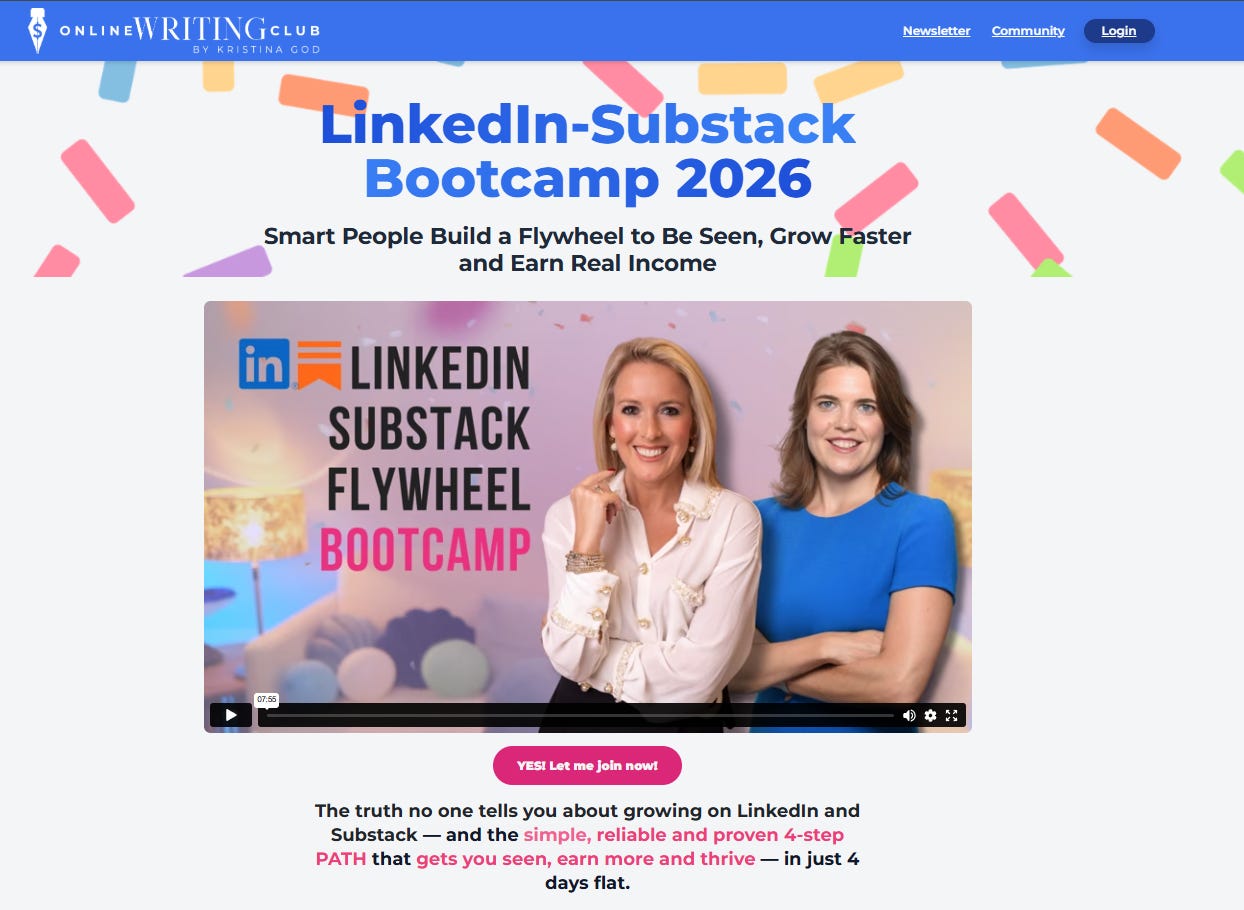
📅 March 10–13
⌚ 11:00 AM ET | 8:00 AM PT | 4:00 PM UK/Scotland | 5:00 PM Berlin time, 120 min each day!
Spots are filling up quick!
50 spots left
19 spots left!
14 spots left
👉🏻KRISTINAFRIEND for 50% off
🤫Psst! The next 3 bootcampers get StackBuddy (Substack Notes scheduling + more) FOR FREE to unmute yourself and be seen on Notes - but escaping the content hamster wheel.

……..
There’s something big happening right now: LinkedIn just replaced its algorithm.
The most trusted platform on the internet quietly replaced its entire content ranking system with one AI driven engine called 360Brew (I learned it has nothing to do with coffee!🤣) . And almost no one is talking about it.
This ONE algorithm preferenes relevance and depth. The platform now rewards people who clearly own a topic and stay in their lane. Your profile has to match your expertise. Your posts have to go deep.
And the good news: Small accounts can now beat big ones if the content is tighter and more focused!
That’s why I asked Melanie, co-host of our LinkedIn Substack Bootcamp starting next Tuesday, to write this guest post. She helped me get moving, and when she explained 360Brew, I knew you needed this.
If you’re ready to stop lurking and actually build something, you can join the Bootcamp with the code
KRISTINAFRIEND for 50% off
as I want you to see real results, not just read about them.
Here’s the LinkedIn update you need!
A solicitor I worked with last year had been posting on LinkedIn every single week for six months. Good posts, too. Thoughtful, well-written, genuinely useful to her clients. She’d put real time into it, time she didn’t really have, and the results were depressingly consistent: a handful of likes from colleagues, the occasional comment from someone she already knew, and silence from everyone else.
She asked me what she was doing wrong.
The honest answer was: probably nothing, by the old rules but the old rules no longer apply.
How the LinkedIn algorithm changed in 2026
In mid-2025, LinkedIn users started noticing something odd. Posts from two or three weeks ago were appearing above content published that morning. LinkedIn’s product leadership confirmed it was intentional. What most people took as a minor feed tweak was actually the visible result of a much deeper architectural shift. LinkedIn had replaced its traditional signal-processing infrastructure with two interconnected large language models (LLMs) that read and reason about content the way an intelligent reader would.
For years, the feed worked like a scoreboard. A like was one point. A comment was worth more. Dwell time added another signal. The game was about sending the right combination of inputs to a mechanical system. That system is gone 😳
The new one understands language. It reads your profile as a document. It evaluates your posts as arguments. It builds a live representation of your professional identity and uses it to decide which conversations you belong in.
If your profile is vague, or your content is scattered across too many topics, or your engagement history sends mixed signals, the system simply cannot place you accurately. Your posts don’t get suppressed. They just never reach the people they’re meant for.
That is what was happening to my client. She wasn’t doing anything wrong. She was invisible to a system that didn’t know what to do with her.
The 2 gates your content must pass on LinkedIn
Every post you publish has to clear two sequential stages before it reaches anyone’s feed.
The first is retrieval. LinkedIn starts with hundreds of millions of potential posts and cuts that down to roughly 2,000 candidates for each member, all within around 50 milliseconds. If your content doesn’t make that initial cut, the ranking stage never sees it.
Two systems handle retrieval. FishDB surfaces posts from your connections and followers, but only within a strict 30-day window. This is an architectural constraint. A post that is 31 days old cannot be retrieved, regardless of how good it is. That window is the compounding period for everything you publish.
The second system is the Causal LLM. This is a large language model fine-tuned to generate mathematical representations, called embeddings, of both members and content. Think of your embedding as a point in a vast semantic space that captures your professional identity: what you write about, what you engage with, and what your profile says you do. When someone loads their feed, the system finds content whose embedding is close to theirs. This engine handles suggested content from people you don’t follow, and it updates within 30 minutes of your last activity on the platform.
Here is the part most people miss: The solicitor I mentioned had a profile that described her as a “senior associate with experience across multiple practice areas.” Technically accurate. Semantically useless. The system had no clear picture of who she was or which conversations she belonged in. Her embedding was blurry. So her content went nowhere.
Why your LinkedIn profile is a strategic document in 2026
This is the pain point nobody talks about, because it’s less visible than posting frequency or hashtag strategy.
You can be posting consistently, writing well, and still be invisible, purely because the system doesn’t have a coherent picture of your professional identity. LinkedIn builds your embedding from your headline, your About section, your experience, and your engagement history. The more coherent that picture is, the easier it becomes for retrieval to place your content in front of the right people.
LinkedIn’s own engineering research confirms that LLMs perform best when the most important information appears at the beginning of the input. That principle maps directly onto your profile. The first sentence of your About section and the first line of every post are prime real estate for both human readers and the ranking system.
This also means that the
“I haven’t got time to overhaul my profile”
instinct is worth challenging.
You don’t need to rewrite everything. Tightening your headline and your About opening to reflect the specific sectors, roles, and problems you work on is an hour’s work, at most, and it changes how the entire system reads you.
How the LinkedIn ranking stage actually works in 2026

Once retrieval has assembled its 2,000 candidates, a second, considerably larger system called 360Brew takes over. Its job is to reason about each candidate and decide which content is most valuable for a specific member at a specific moment.
360Brew reads a dynamically constructed briefing that includes the viewer’s full profile, a curated slice of their recent engagement history, and the complete text of your post. It is, in effect, answering a very specific question: given who this member is and what they have recently found valuable, how likely are they to engage meaningfully with this?
Relevance now outweighs recency within that 30-day window. A three-week-old post that closely matches a viewer’s professional interests will outrank something published this morning that does not.
The system is evaluating your content as a piece of reasoning, which means sloppy, vague, or incoherent writing is far easier to demote now. Clear argument, specific professional context, and well-structured thinking are ranking signals in a way they simply were not before.
The consistency trap on LinkedIn
The second thing I hear constantly from time-poor professionals is this:
“I know I should be more consistent, but I just don’t have the time.”
It’s a reasonable concern.
It’s also, under this architecture, slightly the wrong framing.
Volume and velocity matter less than they used to. The algorithm no longer rewards you simply for showing up frequently. It rewards you for creating content that remains valuable over time. A well-constructed post from three weeks ago can still be surfacing in relevant feeds today. A rushed post published daily to “stay visible” may never make it through the first gate at all.
The better use of limited time is depth over frequency.
One post a week that is clear, specific, and genuinely useful to your professional audience will build a stronger signal in the system than four shallow updates chasing engagement. You are building a library that the ranking system references every time it evaluates a new piece of your content.
A smaller library of genuinely good material is worth more than a large volume of noise.
Engagement is training data
One more shift that changes how you should be spending the time you do have on LinkedIn.
On old LinkedIn, a like was a point on a scoreboard.
On new LinkedIn, a like is an example the system learns from. When you engage with a post, the system stores a record of that interaction: what the post was about, who wrote it, and how you responded. The next time it evaluates content in that topic area, your past engagement becomes part of the context it uses.
A small number of high-quality comments on posts that genuinely relate to your professional domain is worth considerably more than scattering likes across unrelated content. The system reads the text of your comments to refine its understanding of your professional identity. A substantive comment on a relevant post does more for your visibility than ten rapid likes on loosely related content.
Before you publish something important, spending ten or fifteen minutes engaging on the same topic first warms up your engagement history.
The system is better primed to contextualise your new post when your recent activity already signals the same subject.
What “good” LinkedIn writing looks like in 2026

The solicitor I mentioned at the start made three changes:
She rewrote her headline to name her specialism precisely.
She tightened her About section to front-load the client problem she solves.
She shifted from posting whatever was on her mind to writing one focused, well-structured post per week on a narrow set of topics.
Within a month, the right people were finding her content. Not thousands of them. The right ones.
That is what aligning with this architecture actually looks like. Not gaming anything. Not finding new hacks. Communicating with enough clarity and coherence that the system can do its job and connect your thinking with the people it is relevant to.


The #1 LinkedIn-Substack Bootcamp

Next week, Kristina God and I are running the LinkedIn-Substack Flywheel Bootcamp 2026, a 4-day programme where we take these principles and turn them into concrete, repeatable workflows.
If you want to understand how to make LinkedIn and Substack work together rather than treating them as two separate tasks competing for the same limited time, it may be worth a look.
📅 March 10–13
⌚ 11:00 AM ET | 8:00 AM PT | 4:00 PM UK/Scotland | 5:00 PM Berlin time, 120 min each day!
Spots are filling up quick!
50 spots left
19 spots left!
👉🏻KRISTINAFRIEND for 50% off
🔥🔥You’re on LinkedIn? Let’s connect! You can also share your link here in the commets🔥🔥
♻️♻️Re-stack this Guest Post from Melanie & Help Others Grow + keep The Online Writing Club with indie publisher Kristina God alive♻️♻️
 | A guest post by
|
I really hope this provides a transparent practical explanation for people who have been confused as to why their posts have been struggling
I used to be very active on LinkedIn but got frustrated that it wasn’t growing my business, although I made a number of friends in the community. I’ll definitely have to check it out now!
https://www.linkedin.com/in/julesmorey?utm_source=share&utm_campaign=share_via&utm_content=profile&utm_medium=ios_app