


When I first started writing online in December 2020 as a non-native speaker from Germany, I thought I had a pretty good sense of what “good online writing” looked like. Then AI came along. And suddenly, the things I had been taught in college and university, the things I thought were just normal, started showing up on lists as “signs you used AI.”
As a non-native who had only been to America once during honeymoon and to UK twice in her teenager years, this hit me in a strange way. I learned certain structures in English class. I leaned on them. But now? Apparently, they scream “robot.”
Same with emojis. In copywriting, you use them to evoke emotion. I loooove using them. In my newsletters, they’re everywhere. They add flavor, personality, and a wink to the reader. Similar to GIFs. But when it comes to AI detection, emojis are another “tell.”
Or bullets. Everyone says our attention spans are like goldfish. That’s why copywriters break things into bullets. It works. And yet AI uses them too, and suddenly they’re suspicious.
AI Is A Copywriter
In my early blogging days, back in 2020, I recall when listicles were the hottest thing on Medium. Then Medium banned them for being overused. And in Germany, editors from top-tier magazines were literally publishing books built out of listicles. Parenting tips. Gardening hacks. You name it.
So here’s the paradox. A lot of the things AI gets “accused” of doing are also things copywriters and online writers have been doing and teaching others for years. I’ve taken copywriting classes and storytelling classes with writers who learned in Hollywood. I learned “writing” when I was serving my clients as part of the world’s biggest CommsMarketing agency, Edelman.
And honestly? AI sounds more like a copywriter than an essayist or a novelist.
That’s also why, when it comes to marketing, the playing field feels completely different now.
Suddenly, everyone has access to promotional words. Everyone can sound like they know what they’re talking about, even if they’ve never written a sales page, newsletter, blog, or script in their life.
Is that a good thing? A bad thing? I’ll let you decide.
Your Readers Are AI-Aware
However, it is essential to address the elephant in the room. Because in an AI-saturated world, readers are more discerning. They want to know if your words are really yours:
Did a human write this?
They want to feel your unique “writer thumbprint” (oh, and using “…” as we do in German, can also be a sign).
In one of the masterclasses inside the Substack Notes Bootcamp, alum and co-host Sara Redondo, MD critiqued a post on Notes. One of our bootcampers had kindly shared an AI-generated post modeled after her viral hits. We spotted the usual signs right away.
In addition, when paid members send me their guest posts, I often tell them I bet they used AI to write that and ask them to “make the story more human and more them, add more details, messy anecdotes, add pictures, and make it more personable and date to be vulnerable ”.
Wikipedia Just Published A List of AI Signs
Wikipedia published a list of the signs of AI writing, which, honestly, might be the best one available, given the numerous people working on it and the countless sources cited.
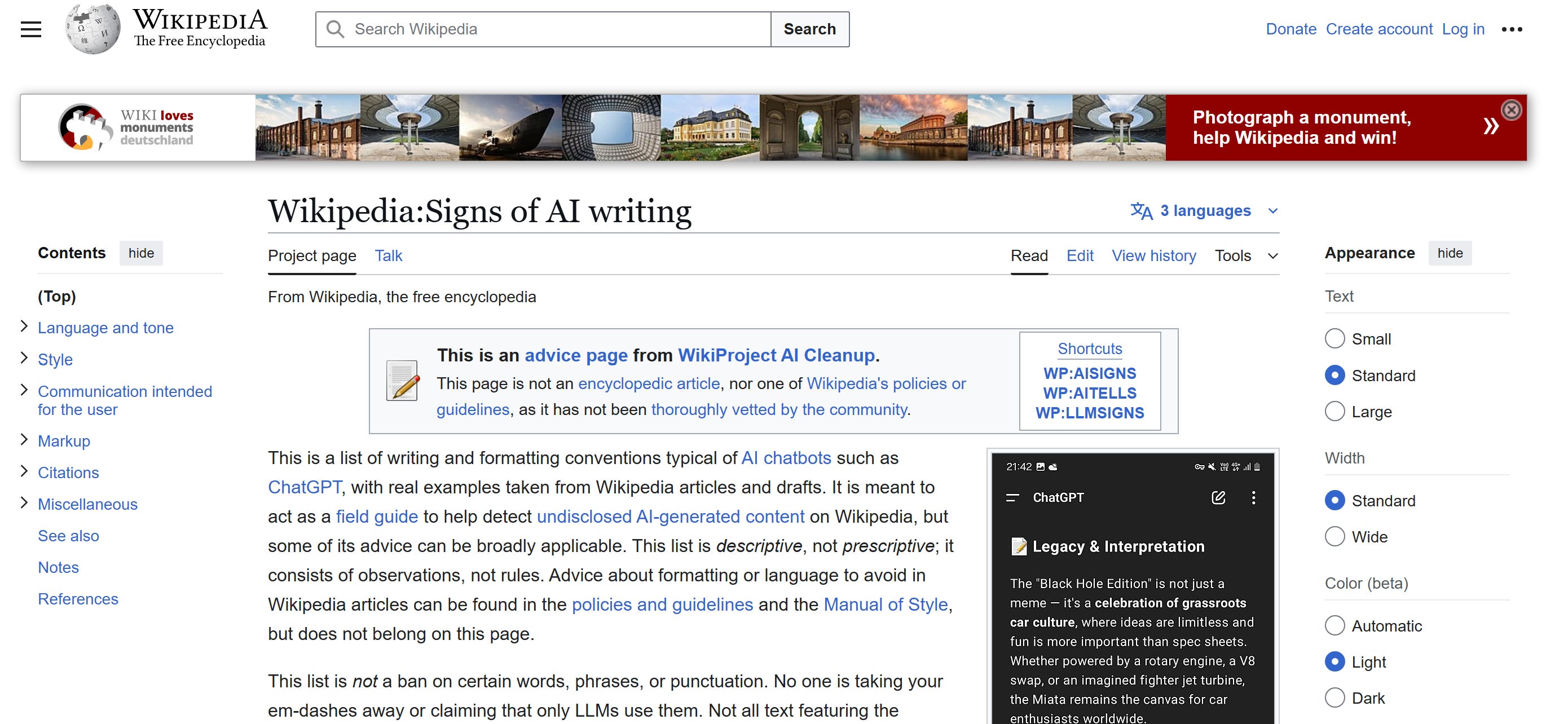
Sure, there are dozens floating around. On YouTube. On Medium. On Substack. I remember when Zulie Rane (a viral Medium writer and influencer, now a Medium staff member with a baby in the house) had an editor review an AI-written story. I remember all the viral posts on the blogging platform about “how to spot ChatGPT words”.
I was even talking with Sean Kernan (Son of Quora and top Medium writer with 100,000 followers) about that one AI piece that blew up on his Substack when we were recording our podcast two weeks ago.
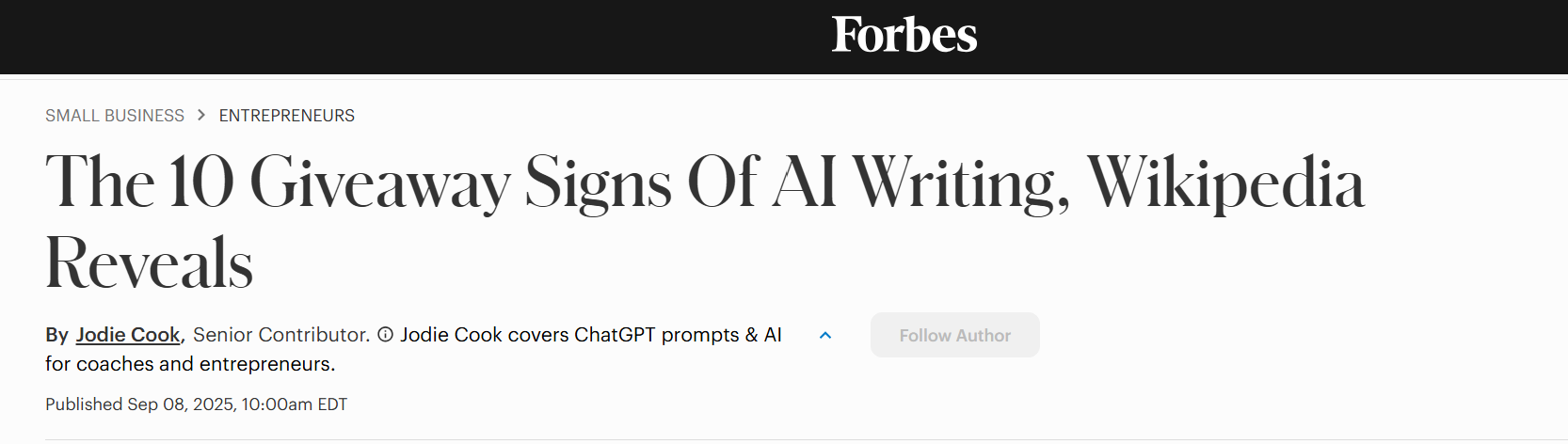
So here’s a detailed checklist to help you spot and avoid the most common signs of AI writing, based on Wikipedia’s own guidance and additional commentary from a Forbes article by senior contributor Jodie Cook, who covers ChatGPT prompts and AI for coaches and entrepreneurs.
**Please note the “my tip” I added is just me adding my two cents while I’m going through the Wikipedia list. It’s not that I’d tell anyone to do this and not that. It’s painful to see that so many of the words I use are “AI tells,” so this is my first approach to talk about this topic in The Online Writing Club. I hope it sparks a conversation and helps us all become better writers.**
1. Rule of Three
The problem is AI writing falls into patterns. Three‑part lists are catchy, but AI uses them everywhere. So it becomes predictable.
Wikipedia says that “LLMs overuse the 'rule of three'—"the good, the bad, and the ugly". (…) While the 'rule of three', used sparingly, is common in creative, argumentative, or promotional writing, it is less appropriate for purely informational texts.”
Words to watch:
triads!
Ex 1: Global SEO professionals, marketing experts, and growth hackers
Ex 2: Convenient, efficient, and innovative (Forbes)
Ex. 3: Keynote sessions, panel discussions, and networking opportunities.
My tip: Vary your examples. Patterns are nice, but I wouldn’t solely rely on them.
“Sometimes you need two examples. Sometimes four. Let the content determine the structure,” shares Jodie from Forbes.